
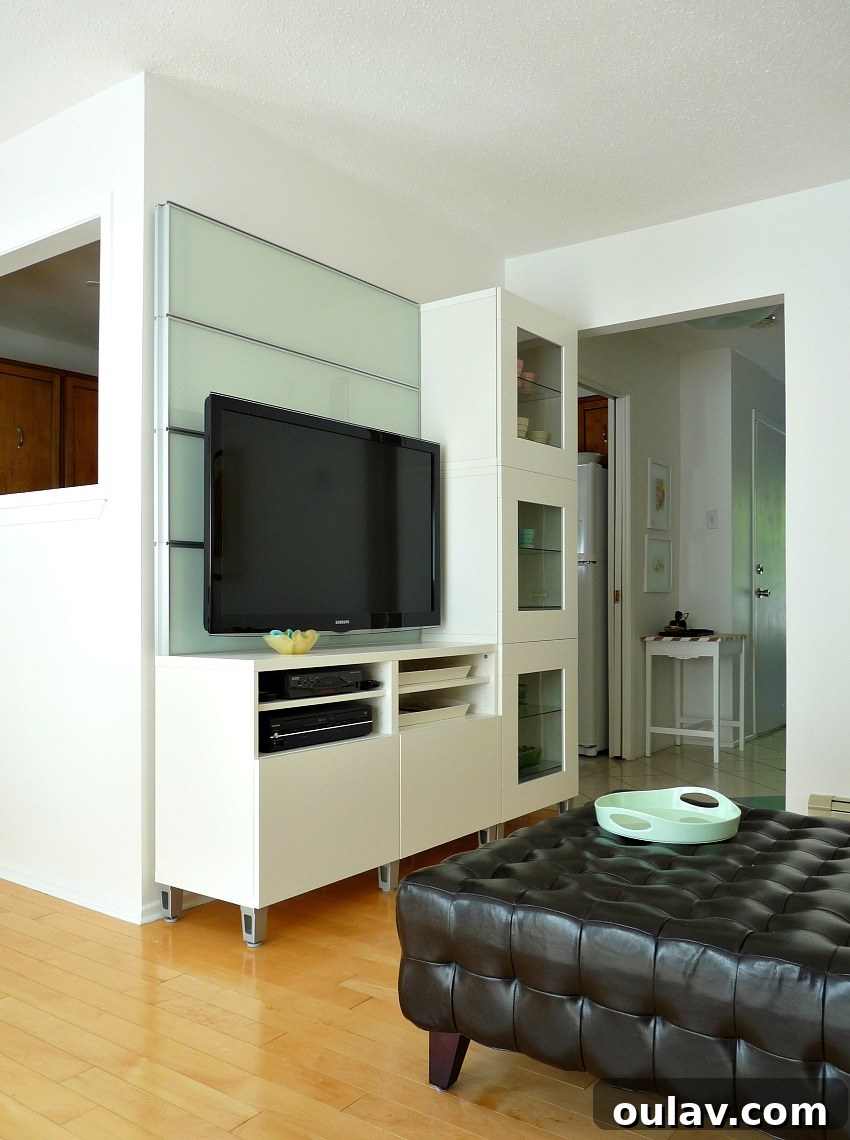
In the quest to create a harmonious and functional living space, one question frequently arises for homeowners and renters alike: how do you effectively store and display your television? Many readers have asked us about our approach to this common interior design challenge. While some dream of elaborate custom-built solutions, our particular setup isn’t a complex DIY project born from weeks of meticulous planning and construction. Instead, it’s a testament to the versatility and practicality of modular furniture – specifically, the Ikea Besta series. As one of only a handful of Ikea pieces we own, it may not be custom-made perfection, but it serves our needs beautifully and has earned a special place in our home for several compelling reasons that we’re excited to delve into.
Finding the ideal TV storage solution is about balancing aesthetic appeal with practical considerations. In today’s homes, where flat-screen televisions are often central to living room design, integrating them seamlessly into the decor while managing unsightly cables and maximizing space can be a real challenge. Our journey to the perfect wall unit involved a mix of aspiration, pragmatism, and a dash of spontaneous decision-making, ultimately leading us to a solution that not only enhances our home’s functionality but also brings a smile to our faces. Let’s explore why this particular media console has proven to be such a success for us.
The Happy Compromise: A Wall Unit for a New Flat Screen
Moving into a new townhouse brings with it a cascade of decisions, especially when it comes to furnishing and decorating. For us, one of the most significant negotiations revolved around the television. My husband, ever eager for the latest in home entertainment, longed for a new flat-screen TV. However, I had one firm condition: no expensive, giant screen would grace our living room until we had a proper, sturdy unit to house it. The thought of placing a valuable new television on our old, somewhat wobbly dresser – the one that precariously held our ancient tube TV – filled me with dread. Visions of a catastrophic crash, followed by tears, spurred my resolve for a secure and stylish solution.
Months rolled by, filled with endless sketches, research into various DIY media console designs, and spirited discussions about potential materials and layouts. Despite our best intentions and considerable planning, we seemed no closer to bringing our DIY wall unit dreams to fruition. Hubby, growing increasingly disheartened by the delay, became visibly sad, his hopes for a grand cinematic experience fading with each passing week. Then, one afternoon, an idea sparked, born of both necessity and a desire to see him happy. I turned to him and proposed, “How about we just head to Ikea, pick out a wall unit, and buy a new TV this afternoon?” The look of sheer joy and gratitude on his face was unforgettable. I’m fairly certain he’s never loved me more than in that moment. Making my husband happy by finally acquiring that much-desired flat-screen television and a suitable display unit stands as the number one reason I adore our Besta wall unit. Beyond the sentiment, I must admit, I’ve grown quite fond of our movie nights with the immersive experience of the bigger screen too!
Seamless Integration: Hiding the TV, Even Without Doors
One of the persistent challenges in designing a cohesive living space, especially in a compact townhouse, is how to integrate a large television without it dominating the entire room. Our living room, as charming as it is, is decidedly on the teeny side. This means that furniture placement is critical, and every piece must work hard to serve multiple functions while maintaining an open and inviting atmosphere. Based on the layout, the most logical and aesthetically pleasing arrangement positions our wall unit as the first thing visitors encounter upon entering the front door.
However, clever design choices have ensured that the television doesn’t immediately assault the senses. By strategically adding a display cabinet to the right of the television, we’ve created a visual buffer. This cabinet, filled with decorative items and books, subtly draws the eye away from the screen itself, softening its impact. As a result, guests aren’t immediately confronted by the presence of our TV; in fact, from certain angles, it’s barely noticeable, blending effortlessly into the overall decor. This discreet integration is a significant advantage, allowing the living room to feel like a comfortable gathering space rather than just a dedicated media room.

Before this carefully planned setup, the situation was quite different. Our previous mid-century dresser, though painted white, left much to be desired in terms of its ability to integrate the television gracefully. Its open design and lower profile meant the TV was far more prominent from the doorway, instantly grabbing attention and somewhat disrupting the flow of the room. The contrast is stark, highlighting the importance of thoughtful furniture selection and arrangement in achieving a harmonious living environment.

The Magic of Cable Management: No Messy Wires!
Ah, the bane of modern home entertainment: messy wires. They are a common source of frustration, detracting from even the most meticulously designed spaces. From almost any direction, it’s clear that our wall unit houses a television, but what isn’t immediately obvious – and what truly brings me immense satisfaction – is the complete absence of visible wires. This is a crucial feature for anyone striving for a clean, minimalist aesthetic in their living room.

The genius behind this seamless look lies in the design of the unit itself. The television mounts directly onto specialized panels that fit snugly against the wall. These panels are engineered with integrated channels and compartments designed specifically to encase and conceal all the necessary cables – power cords, HDMI cables, audio wires, and anything else connected to the entertainment system. This smart cable management system prevents the unsightly tangle of cords that so often plagues media setups, making for a much tidier and more sophisticated presentation. While I initially harbored a desire for a fully closeable unit with doors to completely hide the television when not in use, the layout of our small living room simply doesn’t allow enough space for doors to open without obstruction. However, the visual appeal of the unit’s design, particularly the pretty sea glass green panels that frame the television, more than compensates for the lack of doors, adding a subtle touch of color and personality to the room.

The transformation from our previous setup in terms of cable management is truly remarkable. Before, a chaotic jumble of wires was always visible, along with the less-than-attractive back of the television and the clunky cable box. It was a constant eyesore, and for someone like me who is utterly obsessed with and deeply loathes visible wires, it was a perpetual source of annoyance. The current setup is infinitely superior, offering a clean, streamlined look that contributes significantly to the overall sense of order and calm in our living room. It’s proof that thoughtful design can solve even the most aggravating everyday issues, turning a source of frustration into a feature to admire.

Stylish & Functional: The Aesthetic Appeal of the Besta Unit
Beyond its practical advantages, another significant reason for my affection towards our Ikea Besta wall unit is its sheer aesthetic appeal. When we initially conceived of a DIY unit, I wasn’t entirely confident I could design something as visually pleasing and functional as this modular system. Perhaps now, with three years of living with it and ample time to concoct and execute an elaborate plan, I might approach a DIY project differently, but at the time, the Besta offered an undeniable elegance.
I particularly love the combination of the sleek white framework with the glass elements – the glass panel on the display cabinet, the clear glass shelves within the storage cubbies, and the glass doors that protect items while still allowing them to be showcased. This choice of materials contributes significantly to an airy and open feel. Despite the unit’s considerable size and its role as a central piece of furniture in the living room, it doesn’t overwhelm the space. Instead, the white and glass design creates a sense of lightness, preventing the room from feeling cramped or heavy, which is especially important in our smaller townhouse.
While I’m not entirely in love with the standard legs that come with the unit, we are certainly not going to undertake the considerable effort of dismantling the entire structure just to change them. It’s a minor detail in the grand scheme of things. One day, perhaps, I’d aspire to a media unit crafted from more premium, higher-quality materials, but for now, this Besta system has exceeded our expectations in terms of durability and performance. It has weathered daily use beautifully, proving to be a robust and stylish foundation for our home entertainment. Its modular nature also means that, theoretically, it could be adapted or expanded in the future, adding another layer of versatility to its appeal.


The Perfect Fit: Modular Design for Tricky Spaces
In smaller homes or those with unconventional layouts, finding furniture that fits just right can be a monumental task. This is where the beauty of modular systems, like Ikea’s Besta series, truly shines. The ability to configure individual components to create a custom-looking unit that perfectly addresses specific spatial constraints is an invaluable advantage. In our case, the modularity of the Besta system allowed us to create a wall unit that, against all odds, fits our living room like a glove. Whew!
The precision of this fit is particularly evident near our basement door. There’s only a minuscule amount of room to spare as the basement door squeaks by the edge of the wall unit. This tight clearance demonstrates how crucial accurate measurements and the flexibility of modular furniture can be in maximizing every inch of space. Had we opted for a fixed, pre-assembled unit, it’s highly probable we would have encountered significant spatial conflicts, either impeding the door’s function or forcing us to compromise on the size and scope of our media storage.
The fact that this unit not only accommodates our television and associated electronics but also integrates seamlessly into a challenging corner of the room, without obstructing essential pathways, is a testament to the thoughtful design of the Besta series. It underscores why modular furniture is often the ideal solution for those navigating the complexities of small-space living, allowing for personalized configurations that adapt to the unique architectural features of any home. This perfect fit isn’t just convenient; it contributes significantly to the functional efficiency and perceived openness of our living area.

Ultimately, our Ikea Besta wall unit has proven to be an unexpectedly perfect solution for our television storage needs. It addressed the immediate desire for a new flat-screen, cleverly conceals wires, offers a sleek and modern aesthetic, and, crucially, fits impeccably into our living room’s unique dimensions. It represents a successful compromise between DIY ambitions and practical readiness, delivering both functionality and style.
We’ve certainly grown accustomed to seeing our television beautifully integrated into this unit, but the dream of a completely hidden television – perhaps one that retracts or is encased behind sliding panels – still lingers! We’re always curious about how others tackle this universal challenge. How do you store your television in your home? Did you invest in a pre-made wall unit like ours, or did you embark on a creative DIY project to transform something into cool, customized television storage? Perhaps you’ve come up with an ingenious way to make your TV disappear when not in use. We’d love to hear your ideas and see your solutions! If you have a clever TV storage idea or a blog post detailing your setup, please share your link in the comments below. Let’s inspire each other with innovative ways to blend technology and interior design harmoniously.